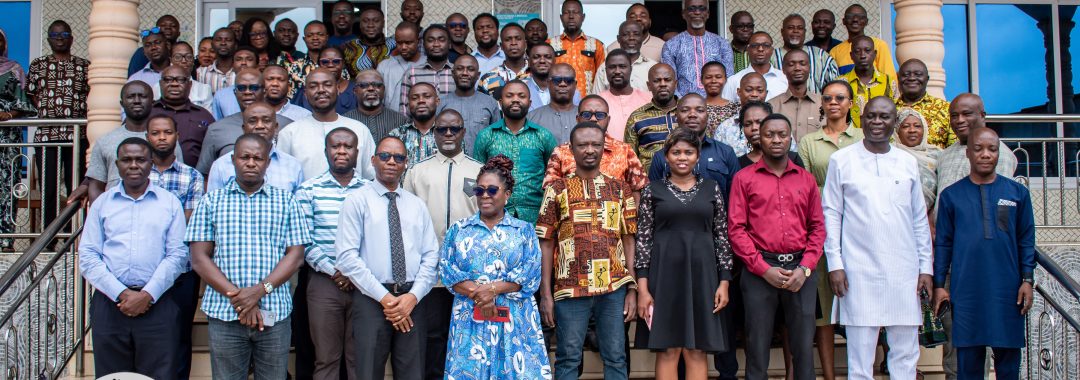
The Office of the Head of the Local Government Service (OHLGS) has completed a 2-day training workshops each in two zones to equip officers from Regional Co-ordinating Councils (RCC and participating Municipal Assemblies on the effective use of the dLRev software for revenue management.
The training workshops which were held in two zones were under the Ghana Secondary Cities Support Programme (GSCSP). The first zone was held from 13th to 14th July 2026 in Cape Coast for Municipal Assemblies from Central, Western and Western North Regions. The second zone followed from 16th to 17th July 2026 in Ho the Volta Regional Capital for RCCs and Municipal Assemblies from Eastern, Volta and Oti Regions.
In a speech, the Head of the Local Government Service, Professor Lord Mensah urged Metropolitan Municipal and District Assemblies (MMDAs) to embrace Information and Communication Technology (ICT) as the key to plugging revenue leakages and increasing Internally Generated Funds (IGF) for local development.
Prof. Lord Mensah said the traditional manual revenue collection systems were no longer fit for purpose in today’s fast-changing world. “Revenue generation remains the backbone for effective local governance. Without adequate and proper utilisation of revenue, it becomes extremely difficult for the Assembly to provide quality services in areas such as sanitation, education, health, infrastructure and social interventions,” he said.
” He added that manual systems are often slow, prone to errors, leakages and sometimes lack transparency as well as accountability. This is where ICT comes in as a game changer,”.
According to the Head of Service, digital platforms such as electronic billing, mobile money payments, revenue management softwares and real-time reporting tools enable MMDAs to automate collections, improve data accuracy, minimise leakages and increase public confidence.
Prof. Mensah said the success of ICT-driven revenue management depended not only on technology but also on attitudes and discipline.
“The success of ICT-based revenue management does not depend only on technology, but also on our attitude, commitment, and willingness to embrace change. It requires discipline, integrity, and collaboration among Revenue Collectors, Supervisors, Finance Officers, and Management,” he stated.
He urged participants to actively engage facilitators, share experiences and see ICT as a tool of support, rather than a threat to their work.
“I am confident that this training will mark a significant step towards modernising revenue management, increasing IGF and supporting sustainable development at the local level,” Prof. Mensah added.
The four-day workshop equipped about 150 participants with practical skills in digital revenue collection systems, dL-Rev software operations and data-driven decision-making for revenue performance. Participants included Co-ordinating Directors, Development Planning Officers, Management Information System Officers, Budget Analysts, Finance Officers, and Physical Planning Officers from participating MAs in the Central, Western and Western North Regions for zone 3 and, Volta, Oti and Eastern Regions for zone 4.
The training forms part of the OHLGS capacity-building mandate under the GSCSP, which supports participating Municipal Assemblies and Regional Co-ordinating Councils in areas including revenue administration, computerisation, monitoring of municipal services, urban resilience and local economic development.
The GSCSP is a World Bank-supported programme aimed at strengthening urban management and service delivery in participating secondary cities across Ghana.